¡LOVE MEXICAN STYLE!
They arrive, greet warmly and take a seat. They order french fries
with melted cheese and strawberry juice. Inevitably, the
conversation's first subject is food: In Mexico, there isn't any
flour bread, "torontos", white cheese, "malta" or "Mariá" crackers.
Outside the capital, however, there are blue corn fields with which
to prepare divine "quesadillas". Hot spicy foods were a problem for
Miguel de León. Gabriela Spanic, on the other hand, had the
pleasure of daring more than a few Mexicans and beating them all without
difficulty because at home as a child, she was taught to eat hot spicy
foods.
Mexico isn't Venezuela and the climate, family, friends and co-workers
turn into conversation topics on more than one occasion because they're
part of a life that's never left behind. On informing them of the
havoc that "La Usurpadora" has caused in the Venezuelan ratings, they
show concern: "It worries me because, after
all, they are our co-workers".
Gaby still displays a shyness that neither the Miss Venezuela pageant
nor three leading roles, nor her popularity in the land of the Aztecs
have been able to erase. During the photo session, someone shouts
from a car: "Paulina!" and she just about dies from the
embarrassment: "Everyone's going to look at
us."
GABRIELA: In Mexico, you'll
never see a blue sky nor a yellow sun. The traffic is worse than
here. In the beginning, I would get bad nose bleeds, my skin would
peel and I couldn't breathe right because it's a very high [in altitude]
city. The capital has 23 million inhabitants. I wasn't
expecting it so big! But I love the public. They're very
cheerful and loving. They don't care if you're a foreigner.
NEW YEAR, NEW LIFE...
GABRIELA: It was a splendid
opportunity. I always dreamed of being internationally-known
and it happened all of a sudden... after doing Amaranta in "Todo Por Tu
Amor". It was difficult to arrive in a country where I didn't know
anyone, except through [their work in] the telenovelas, and to meet their
expectations which were pretty high. I had to be conscious of my
"J"s and "S"s, of the earphone and of changing the pitch of my voice for
each character. This year was a radical change [for me]:
matrimony, a new home, a new country and a new novela. We
spent the first of January [1998] on board the plane that was taking
us to Mexico.
What awaits you in "El engaño de un hombre"
(Deceit of a Man) and "La otra" (The Other)?
GABRIELA: I still don't know
much because in television everything changes from one day to the next.
I would love it if the story was different this time, like
Nohelí Artega in "Las dos Dianas" (The Two Dianas) or like the
three sisters that Lucero played in "Lazos de amor" (Bonds of Love).
You're leaving on September 20th. Why
so soon?
GABRIELA: I don't want to
leave yet but Televisa wants to prepare me with acting, dancing and
singing classes. I'm willing to take them. I believe an
actor should learn something every day. It's a world full
of unknowns. Worlds unfold in one's course through life.
GUARDIAN ANGEL
Miguel de León's eyes light up as he talks about his wife's
adventures. He listens to her as she speaks; he stands by her; and
he relishes her triumphs with a splendid smile and with the satisfaction
of knowing he's an important part of that dream which is just beginning.
MIGUEL: It's important for the
public to understand that when someone goes to Mexico, it doesn't matter
what country they're from, that person is obligated to neutralize
their accent. We would like to speak Venezuelan everywhere but
the boss rules. In December [1997] and January [1998], we took a
speech course to neutralize our accent. I didn't find it too
difficult because I used to be a voice and diction instructor.
How did your participation in "La Usurpadora" come
about?
MIGUEL: It was presented to me
as a joke. It was best for me to do it even though I ran the risk
people would think she had insisted I be in the novela. I want to
make it clear Gaby did not exert any pressure and we're grateful to
Mexico's viewing public for having accepted us in such a special way.
If you were to receive an offer from Venezuela or
Colombia, would you be willing to leave Gabriela for a while?
MIGUEL: We've stayed together
this first year of marriage. There were projects I didn't accept
precisely because of that. But an actor's career can't stay
stagnant. If necessary, we have the sufficient trust in each
other to take on that phase. Each one has his/her career that
still needs to be nurtured.
When will it be time for the children?
MIGUEL: Three years from now
because, at this moment, she needs to reflect on what's happening to
her and take advantage. Having children transforms you into a
much more responsible person because the focus is no longer solely on
your life; it is now on the lives you have procreated.
What is Miguel like?
MIGUEL: In all cases,
unconditional. My parents can count on me for anything. The
same goes with my siblings and with my wife including her family.
DID YOU KNOW THAT...?
"Todo Por Tu Amor" was airing in Mexico at noon but was switched to
the wee morning hours when they discovered Gabriela would be starring
in the other channel. Anything to not drum up propaganda for
"La Usurpadora".
 Close to Paulina's house [in "La Usurpadora"], there was a ladder
leading to a small bridge. As Gabriela was walking, framed in a
tight close-up shot, she suddenly disappeared. Everyone who was
watching the camera monitor couldn't figure out what was happening.
What happened was she had fallen down and was on the ground
cleaning herself off: "It was like a cartoon.
I didn't even roll down. The producer kept asking,
'Where is she?'".
Close to Paulina's house [in "La Usurpadora"], there was a ladder
leading to a small bridge. As Gabriela was walking, framed in a
tight close-up shot, she suddenly disappeared. Everyone who was
watching the camera monitor couldn't figure out what was happening.
What happened was she had fallen down and was on the ground
cleaning herself off: "It was like a cartoon.
I didn't even roll down. The producer kept asking,
'Where is she?'".
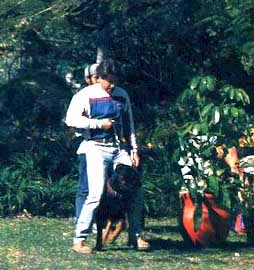
The dogs in "La Usurpadora" were seemingly vicious. But
according to Miguel: "They were very docile.
I would sit on them and they'd be happy."
Concerning the anecdotes on filming the double roles, both coincided
"they were very arduous and no one made light
humor of them".
POINT BLANK
We sat Miguel and Gabriela down at different tables and asked them the
same questions. Here are the results:
What type of friendships must one be wary of?
MIGUEL: There are individuals
to be cautious of but not friendships because those are the people
one trusts. I'm wary of those who talk too much.
GABRIELA: If they demonstrate
their worthiness to me, I come to trust them. The Gabriela of the
past used to think everyone was a good person. Thank God, in my
case, there have been more good people than bad. I think the first
thing is to take care of your essence, your humbleness; to love what you
do and to be authentic. The viewing public sees more than one imagines.
They can see the interior and the soul.
What annoys you?
MIGUEL: Injustice, first of
all, and envy. Everyone has what they should have. I don't
like thinking about something that someone else has obtained and I
haven't; it seems belittling to me [to think that way].
GABRIELA: Envy because even
though we may not realize it it could finish the world. I don't
understand or accept how there can be so much misery in a country as
rich as Venezuela; how so many good people from the hills can't get
ahead because of all the bad influences. I also can't stand to see
a child begging in the streets.
What is an actor's mission?
MIGUEL: To entertain the
public in a delightful manner; to have them identify with my feelings,
with the feelings I'm trying to convey. We're the healers of the
soul.
GABRIELA: To demonstrate to
the people one can say "I love you"; that one can be tender,
nurture love, hold high values. I try to always convey
peacefulness. I like to do rose-colored novelas. Cultivating
that fantasy is a mission.
If you were ever to decide to leave acting, what
would you do?
MIGUEL: That's tough.
I've been an actor all my life even though I've studied many
things: engineering, administration, anthropology. I can
still see myself in this ten years from now. But after that, I
would be content to own a little store where I would simply make my
sales and close at seven.
GABRIELA: I would love to see
myself with children. I don't want to spend my entire life in this
career because the actors that reach their golden years are mistreated.
They have all those years and all that experience but they don't
have the place they deserve. I prefer to take advantage of my youth;
to save my money, retire and start a modeling and acting agency for
children or a fashion-designing business.
What do you want from life?
MIGUEL: Good health because
everything else should be obtained by me. I would love to
continue in this career doing novelas, cinema, theater and to live
my golden years in a tranquil, peaceful manner... in an attractive,
unassuming and cozy place. My goals are not big. I'm not
an ambitious person. My goal is to have good roles within my
career; roles that will make me feel alive. I would die happily
just knowing Gabriela loves me.
GABRIELA: I want to have a
large family because I have twelve uncles and numerous cousins. I
consider myself fortunate. There are many people who have
everything [in life] and who still complain because they don't see
themselves in the shoes of others who have it worse. I pray to
God for good health for the world, for my family and for me
too.
|