 |
Electron Transport Chain |
| Class, for Exam 2, I want you to know these FIVE Steps of the ETC. Please learn them well. Also, for EXAM 2, I will ask you to DRAW out the ETC as well, so please practice drawing! Class I have TWO YOUTUBE videos that exlain the ETC. CLICK HERE for YOUTUBE video Part ONE |
||||||||
 |
||||||||
 |
||||||||
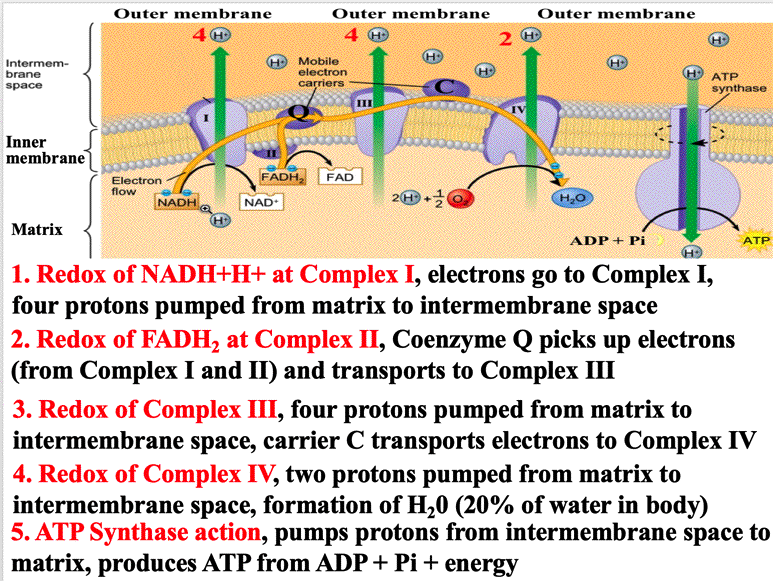
| HI CLASS, BEFORE READING ANY FURTHER, PLEASE CLICK HERE AND WATCH THIS WONDERFUL INTROCTION MUSIC VIDEO ON THE ETC. Class, CLICK HERE to see a LARGER graphic of the ETC. Class, CLICK HERE for a YOUTUBE video explaining the ETC Class, below is an explanation of all of the steps occuring in the ETC: The electron transport chain is composed of four protein complexes, which are embedded in the inner membrane of the mitochondrion, along with two mobile carriers (mobile carrier Q {coenzyme Q} and mobile carrier C, that shuttle electrons through the ETC. The ETC is where the greatest amount of ATP is synthesized. Electron Transport Chain Story Mitochondrial NADH+H+ arrives directly at the ETC from the TCA cycle and immediately oxidizes to NAD+, with its protons (hydrogen ions) remaining in the matrix, and its electrons (e-) going to complex I. As the electrons arrive on complex I, the complex immediately goes through a series of redox (reduction and oxidation) reactions. These reactions create a proton pump within complex I, pumping (or translocating) 4 protons from the matrix through the protein into the intermembrane space. The electrons now transfer to mobile carrier Q, and NAD+ returns to its original source to pick up more hydrogen ions. FADH2 arrives to the ETC from the TCA cycle. FADH2 then oxidizes to FAD, with its electrons and protons going to complex II. FAD then returns to the TCA to pick up more electrons and protons. Complex II goes through redox but it does NOT create a proton pump. Mobile carrier Q also picks up all of the electrons on complex II, and shuttles the electrons it collects to cytochrome complex III. The electrons are then transferred to complex III, which also immediately goes through redox (reduction and oxidation) reactions. This again creates a proton pump, pumping 4 protons from the matrix through complex III, directly into the intermembrane space of the mitochondrion. (NOTE: there are many mobile carrier Q coenzymes present in the ETC, and these molecules are also called ubiquinone or ubiquinol). The electrons are now shuttled from complex III to complex IV by mobile carrier C. As the electrons transfer onto cytochrome complex IV, it immediately goes through another redox reaction. This creates a final proton pump, pumping 2 protons from the matrix through cytochrome complex IV, directly into the intermembrane space of the mitochondrion. Complex IV is the last step in the ETC, and the electrons that have been driving these reactions now need another place to go. To solve this problem, an oxygen atom, which has a very strong attraction for electrons, picks up two electrons from complex IV, along with two some free protons from the mitochondrial matrix, to simply form water (H20). In essence, the FINAL acceptor of the electrons at complex IV is oxygen (which forms water with the protons and electrons it accepts into its structure). This is referred to as 'metabolic water' (because it is made in metabolism), and is actually makes up for 10% - 20% of total daily fluid losses (the rest we must replenish from the fluids and foods we intake). The many protons that this process pumps in the intermembrane space create an imbalance in hydrogen ion concentration (charge) that the cell does not like. All cells prefer homeostasis, so to help relieve this imbalance, ATP synthase (a special protein embedded next to the ETC) pumps several protons at a time back into the matrix. As these protons move into the matrix, enough energy is liberated to phosphorylate (or add another Pi to) ADP, thus synthesizing ATP. The ATP will then leave the mitochondrion and go where energy it is needed in the cells for life processes. End Class, SPECIAL NOTE: In skeletal muscle fibers, NADH+H from the sarcoplasm (i.e. from glycolysis) shuttles its protons and electrons to FAD, reducing it to FADH2 at the surface of the inner mitochondrial membrane. This reduced FADH2 will transfer its electrons to mobile carrier Q. CLASS, SECOND SPECIAL NOTE: There are MANY carrier Q and carrier C mobile carriers in the ETC. They transport 2 electrons at a time. Class, Queston: What is the FINAL acceptor of electrons in the ETC? (Answer: Oxygen at Complex IV) Click here for a YOUTUBE video explaining ATP Synthase |
||||||||
 |
||||||||
|